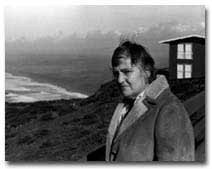
Etel Adnan came to this country to do a masters in Philosophy at Berkeley, then moved on to Harvard. She taught Philosophy and Philosophy of Art at Dominican College in San Rafael, where she also started painting. She is the author of 8 books of poetry, a novel about the Civil War in Lebanon, a book on Paris, a volume of letters and the essay "Journey to Mount Tamalpais" on the relationship between nature and art, as well as her theory and practice as a painter.
The Nomadization of Culture & the Electronic Page
There are two essential elements to the nomadic world: mobility and impermanence.
I see, like tides advancing, nomadic ways of life and of thinking to be overtaking the contemporary world.
The old caravans, which went from Egypt to the Atlantic through the Saharan Deserts, or Eastward to China and Mongolia, were not wanderers or camel herds in search of water, but genuine commercial lines of communication. These caravans carried goods the way trucks and cargoes do nowadays, but more importantly they carried ideas. Goods, in and of themselves, already can imply ideas. They can carry cultural ideas or ideology. For example, the spread of Islamic Revelation in desert regions cannot be explained otherwise, as it involved an area ranging from the Hejaz to Syria, Iraq, Iran, Afghanistan, Central Asia: all being essentially nomadic lands, tribal populations.
The crucial role of nomadism in the spreading of communications (before the advent of the printing press) is duplicated today with the invention and the use of electronic networks. The computer has turned the world into the sustainer of myriads of communication lines where thinking can spread out beyond the old system of printing and diffusing ideas through books which are material objects, heavy and space consuming. We have entered an era where things (meaning messages and thoughts) move instantly, with no visible traces, thus fitting a nomadic society which is more of a servicing society than an object producing one. You can't carry libraries and files on camelback.
The emphasis, for ancient culture, was on memorization. Tribal societies developed poetry at the expense of novels because the former was easier to memorize, and because poetry is a more economical way of thinking than other forms of literature. And the contemporary world is moving in that same direction: the emphasis is made possible, or facilitated, by computers. As the nomad carried his whole culture in his head (usually a basic religious/legal "book" like the Koran, the Bible, Asiatic wisdom books etc.), we are already carrying in a small computer "all the data we need," and pretty soon "all the literature or the knowledge we will want."
Whole societies nowadays are on the move in massive human tides. The panic created in European countries in the face of immigration calls for attention. The influx of refugees and job seekers represents something more than just an economic phenomenon. It is a deeper stirring, the kind of tidal waves that the Crusades were, or other great invasions of the past. But this time there are no generals leading these migrations; these are spontaneous, probably irrational, instinctive movements of populations. Of course there are economic and political factors concerning these migrations, but I think of deeper forces: the human animal is both nomadic and sedentary, but technology, scientific advances, explorations of outer space, have created an environment, both psychic and intellectual, which stimulates, favors, the nomadic, over the conservative, sedentary instincts of humans.
The electronic age is about movement: the simultaneous transmission of (written) thought through e-mail, following the transmission of the spoken through radio and telephone, has loosened the maximum boundaries of the book. Objects containing thoughts, such as books, documents, letters, etc., see their role minimized in this new context. The audience is not limited anymore; thinking is, so to speak, thrown to the winds. This globalization of one's audience reminds us, strangely, of the great imperial periods of History.
In this worldwide feeling of uncertainty some things are certain: on the one hand the mobility of goods and capital is pushed to its extremes, meanwhile the mobility of people is seen as a threat and is being contained (as much as possible). Traditional cultures are breaking down under globalization of objects and ideas, ideas represented not only in books but also through all the arts and architecture, under the power of the web which is a real web. It is as if the world has become a huge spider whose head is nowhere to be seen and its threads create a mesh, which encompasses the whole of the planet.
This mondialisation of practically everything creates its antidote: we cannot go back to the tightly closed nation-states, but are heading towards a new kind of tribalism: the world is breaking down (in a most fluid way), into "groups," "cultural organizations," "communities," which are not linked by cultural space but by a common "network." All of this is made possible by the computer age. In that sense our real neighbor does not inhabit the same street, but rather a similar electronic address. Our audience is not in the same room, but in front of the same electronic page, so that all the groups, some of them overlapping, the societies, the leagues, the networks and associations, organizations, political parties, to which we increasingly belong, become tribes of a new kind which gather periodically and disperse, each member joining other tribes, and this ad infinitum.
Welcome to How2, one of your tribes!