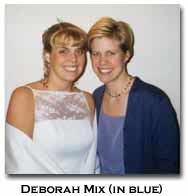
Deborah M. Mix is a visiting assistant professor in the department of American Thought and Language at Michigan State University. She has published articles on Gertrude Stein and Lyn Hejinian in HOW2, no. 3, and her article on Daphne Marlatt and Betsy Warland’s collaborative poetry appeared in the Summer 2000 issue of Contemporary Literature. She is currently at work on a book manuscript that traces a tradition of American women’s experimental writing from Gertrude Stein to the present.
Reading the Way She Writes: Critical In(ter)ventions
During her 1935 lecture tour in the United States, a reporter asked Gertrude Stein, "Miss Stein, why don’t you write the way you speak?" Stein replied, "Young man, why don’t you read the way I write?" (Berry 1). Stein’s question to the reporter has stayed with me. It comes back to me, again and again, as I write literary criticism, as I prepare to teach, as I read or reread. Over the years, I’ve become increasingly concerned with critical voices, both my own and those of others, on the connections (or lack thereof) between the ways in which an author writes and the ways in which a critic reads and speaks about that work. Traditional critical practices, I’ve come to believe, are predicated upon a sense of the critic as a sort of housekeeper: polishing up gleaming surfaces to present to the world, offering neat and tidy explications, and sweeping any leftover textual "debris" under the rug. Such an approach is fairly widespread among literary critics, but the practice seems particularly evident and particularly odious when it is applied to the work of authors, like Gertrude Stein and Lyn Hejinian (and many others), who are working toward the deconstruction of fixity, certainty, authority–precisely the attributes valued in the traditional critical voice. Again and again in my own research, I’ve found the work of innovative writers like Stein and Hejinian being twisted, selectively discussed, even ignored so that it can be fitted into familiar categories, categories where women’s writing and experiment are "allowed." Certainly these strategies are used to contain the radical potential of many voices, particularly when the voice comes from a disempowered location and threatens to unsettle power structures (think, for instance, of past years’ representations of Emily Dickinson as a "madwoman in the attic"). But there is only a relatively small body of work available on experimental women writers. And, as Marianne DeKoven has noted, while the association of a woman writer with experimentalism provides her with a small place in a tiny literary constellation, it also consigns her to a place where it is even easier to miss (or dismiss) her.
Because of the ways in which I read the consequences of these more traditional critical approaches, I know that I cannot participate in them. But figuring out how to sidestep the "bad" elements of such a practice without writing "bad" criticism (sloppy, confusing, pointless, or, worst of all for the academic, unpublishable) has been a difficult and ongoing process. For me, one of the first steps toward writing in a critical voice that seems appropriate to discussions of experimental writing was to relinquish my sense of critical certainty, to admit to and work with the partiality and limitations of any particular way of reading, and to approach the authors and their texts from this "new" position. This process is easier, I think, when the authors themselves are openly uncertain, welcoming the reader who might approach from a different direction, who might be willing to open up a genuine dialogue, rather than to close down possibilities. In Tender Buttons, Gertrude Stein writes, "A white hunter is nearly crazy" (475). Her statement might be read as resonating with Ahab’s quest for Moby Dick, a quest to find a particular quarry in wide open seas, a quest that makes him mad and dooms his voyage. If I approach Stein’s (or Hejinian’s, or…) work as Ahab hunted the white whale, I will become "nearly crazy," and my critical voyage will be doomed as well. The experimental text actively resists that desire for dominance, for colonization by the critic, sometimes forcefully, sometimes playfully. Meanings slip and travel, always moving; concentrating on a single "fish" in a wide open "sea" is to miss the complexity and variety of the text.
The writers themselves often offer direct invitations and challenges to respond to their writing in ways that are speculative, open ended, and unique. Requiring innovative reading, a tolerance for ambiguity, a willingness to frolic, the works can frustrate as well as give pleasure to readers. And these approaches and experiences–uncertainty, ludic play, self-reflection–need to have a place in my criticism. When I look to the works of these authors, I see them offering some suggestions for moving toward an alternative critical practice through their own admissions of tentativeness, enjoyment, and introspection. In The Making of Americans, Stein writes:
Bear it in your mind my reader . . . what I have said always before to you, that this I write down a little each day here on my scraps of paper for you is not just an ordinary kind of novel . . . and so my reader arm yourself in every kind of way to be patient and eager . . . . And so listen while I tell you about us, and wait while I hasten slowly forwards, and love, please, this history of this decent family’s progress. (37)
In her direct address to her reader, Stein creates an intimacy wherein she can confess her desires, as though she is asking a dear friend or lover (rather than, say, a monomaniacal hunter) for a special kindness, a special way of reading. She warns her reader that she is not writing "an ordinary kind of novel" but one that will require patience and eagerness, a kind of commitment that seems qualitatively different from the dispassionate stance favored in most literary criticism. Rather than the formal detachment required of the hunter-critic, Stein imagines a reader who will be very much involved in the work, bringing her own hopes, desires, and personal investments to the act of reading. And Stein approaches that reader with her own combination of hope, desire, and investment, asking her to "love please" the work she has done.
In Lyn Hejinian’s Writing Is an Aid to Memory, one of her earliest works, she muses on the power of authorial and readerly expectations, tracing some of the same pathways as Stein. "that sweet little block / the taste of a larger pattern" emerges from time to time, appearing only to disappear back into "tired mixed trace of chat back" (n.p.). "the readymade is deceptively passing /its consent to time," she writes, "mass perhaps in a form against it / a cheap reading of what surrounds." Here Hejinian asks her reader to reflect on her practices of reading, her desires for the "taste of a larger pattern." And while she seems respectful of that desire (in fact she admits to having it herself), she is also wary of it. Our "readymade" expectations are "deceptive." If we enter a text carelessly, without an awareness of our potential prejudices or proclivities, we’re likely to seize on those elements we seek, those that are already familiar to us, those that fit neatly into our own critical patterns, resulting in a "cheap reading of what surrounds." She offers a similar reminder to her reader in My Life, writing, "But as I’ve said before, I am nearsighted, and there are many figures in this scene which might form different scenes" (97). As herself both reader and writer of her life, Hejinian occupies a unique position that both coincides with and differs from that of other readers. In a break from the kind of distance one might expect from the autobiographer looking back on her life to present it as exemplary or edifying in some way, Hejinian questions her own authority as reader, her own "nearsightedness."
What I want to say here is that the texts themselves can teach us how to read them. In the passages above, the authors speak directly to readers, encouraging them to break the rules of critical discourse. Stein asks for eagerness, tenderness, love. Hejinian cautions her readers to approach the very act of reading suspiciously, flexibly, imaginatively. It’s not so much a matter of being able to "get inside" a particular author’s mind, to suss out her intentions. And it’s also not a matter of writing "sloppy" criticism that piles up possibilities without purpose. Instead, at least for me as a reader and critic and teacher, it’s a matter of letting my prose wander and wonder. I have never been sure how to interpret a marginal comment on one of my grad school papers that said I wrote "like a prosecutor." While I think that professor found that particular essay’s language infelicitous, I also suspect she admired the single-mindedness with which I argued my interpretation of the work at hand. But I am sure that a "prosecutor’s voice" isn’t the one I want to hear from myself as a critic. Rather, I want to hear a bit of the playfulness of Stein, the speculation of Hejinian, and my own sense of my critical practices as being, well, practices, in process.
What remains at the center of my own work as a critic is to consider the ways in which acts of "doing" help to create the "doers." There is an important relationship that I imagine between myself and the authors I read, write about, and teach. Just as my critical work could not exist without their work, they point to ways in which their works are brought into being by readings. Their writing helps me to interrogate the ways that I construct my own identities as teacher, writer, reader, and I return that attention to their works as well–what are they teaching me, writing about, reading into their texts? As I use my critical training to look for the gaps in the texts, I must always be aware of my own. As I think of the ways they unsettle constructions of identity, writing, language, I must always look for ways to unsettle my own ways of seeing, reading, and writing such that I don’t "refix" what is meant to be open ended. The ways in which my own identity is predicated on teaching, writing, and reading have probably occluded my abilities to see the complexities of these dynamics, but I will continue to work toward clarifying my own ways of seeing, my own approaches toward "reading the way she writes."
References
Berry, Ellen E. Curved Thought and Textual Wandering: Gertrude Stein’s Postmodernism. Ann Arbor: U of Michigan P, 1992.
DeKoven, Marianne. "Gertrude’s Granddaughters." Women’s Review of Books 4.2 (1986): 12-14.
Hejinian, Lyn. My Life. Rev. and Expanded Ed. Los Angeles: Sun and Moon P, 1987.
–––. Writing Is an Aid to Memory. 1978. Los Angeles: Sun and Moon P, 1996.
Stein, Gertrude. Everybody’s Autobiography. 1936. New York: Vintage, 1973.
–––. The Making of Americans. New York: Harcourt, Brace, and World, 1962.
––– Tender Buttons. 1914. Selected Writings of Gertrude Stein. Ed. Carl Van Vechten. New York: Vintage, 1945. 459-509.