
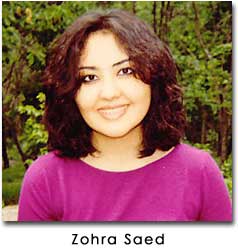
Zohra Saed was born in Afghanistan and came to the United States with her family in 1980. She received her Masters in Fine Arts in Poetry at Brooklyn College. Saed is a doctoral candidate in the English Literature program at The City University of New York Graduate Center and co-editing with S. Wali Ahmadi and Farhad Azad, “Drop by Drop, We Make a River: Afghan Writings of War, Exile, and Return” a ground breaking Afghan literary anthology written in English, which spans the years between 1978-2002. This collection will be published jointly by Up-Set Press Inc. and Afghan American Peace Corp (forthcoming Winter 2003). Currently, she teaches in the Asian American Studies Program at Hunter College and serves on the Board of Directors for Afghan American Peace Corp.
Working Notes
As a poet, I value memories and believe in the healing nature of sharing particularly traumatic memories. The airing out of old wounds is what will help us move ahead to a healthy future as a people from a country which has experienced war continuously for the past two decades. On a personal level, by giving voice to my families’ and my own memories, I am trying to fit us all under the one skin of writing. It is perhaps the only way I've been able to reconnect my extended family, who have been scattered across the globe and suffered tremendous losses since the Soviet-Afghan war.
What the Scar Revealed...
1977, Afghanistan: A girl born on Lailatul Qadr, holy night of Ramadaan.
Her mother tilts her head back to face the sky. The night is smoother than
her amber skin. Young mother sees spirits walking across the sky with stars
blossoming at each step.
The stars join as a single thread of daylight
A gold streak across twilight.
Grandmothers tell the story of healing; how wounds heal only after they have
memorized the moment of hurt. A newborn’s navel is the same as any wound.
To heal, the cut navel swallows the city and remembers its fragrance.
Turquoise domes, spice vendors, pomegranates like hearts, and the adhaan in
her ear are consumed by this bloody wound.
April 1978: A revolution tangles ribs and spines with iron and steel.
Smuggled under veils and old pots, she ties borderlines into knots. After
suckling her mother’s fingers for days in the desert, she throws a tinseled
veil up to the sky and catches lapis-colored doves. Quartered and roasted,
the doves whisper God back into the wanderers’ sleep.
1998, New York City: In an apartment overlooking a blue-gray street, her
mother’s veil hangs on the wall like a talisman. Her lapis doves and
tinseled mountains are misplaced and glorified behind plates of glass at
museums. She visits them weekly and cleans the glass between them.
When Lailatul Qadr comes again, she is over a bridge between Brooklyn and
Manhattan. While the night is threaded in gold, the lost city in her navel
unwinds itself from swirls of skin and slips over this new city like a fog.
Nomad's Market: Flushing Queens
Two hours by train from Brooklyn
to wander in shops named after lost cities,
enamored by bags full of
overpriced ingredients to my parents’ memories.
Holidays have been lonely
since the swarm of children
tugging at my elbows grew up
and went to high school.
Even lonelier since I grew out of frocks
and into ankle-grazing dresses.
The shops are obsessed with maps here and enlarged pictures from Afghanistan.
I can sketch the map in the air from memory:
It’s shape a human heart.
An immense pop singer winks at me
by the meat freezer,
Ahmad Zahir,
who may as well have been Elvis,
guards the freshness of halal.
I remember him from pirate videotapes
passed from neighbor to neighbor
until his face was a white blur on the screen.
But my mother and all seven aunts
danced in the living room.
In the next room,
the children were hypnotized
by Bugs Bunny.
Grand mosques with turquoise domes gleam above plastic bins of tea leaves,
saffron, and dried violets, blessing the shop with prosperity.
The small television
placed on the counter at an angle
run musical videos of beautiful women
singing folk songs from Jalalabad
and Kandahar, decked in gold,
eyes swept with surma.
They keep their eyes averted
and carry themselves as if being arranged in a marriage.
There is no dancing here.
Most likely, it is their husbands who play
the tabla behind them.
Strands of home dance through
aisles of Pepsi and Heinz,
chocolates and cigarettes.
The shopkeeper’s son
circles around me, pretending to
rearrange layers of velvet prayer mats.
He has spotted another exile...