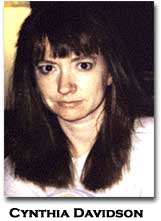
Cynthia Davidson is the editor of Rio: A Journal of the Arts, an online magazine that publishes literary work and artwork (http://www.engl.uic.edu/rio/rio.html). She teaches writing at SUNY Stony Brook. Davidson is the author of Athena's Mother and has contributed poetry and criticism to ACM, ebr, Science-Fiction Studies, and other journals. She is currently working on an article about Alyson Hagy for DLB.
Some thoughts on style
I think that blurring the lines between poetry, fiction, and literary or cultural criticism is a good and necessary thing that is happening of its own accord, not just for women but for everyone. It happens "naturally" because we all see the boundaries differently. The boundaries between gender, genre, class, culture, etc. are of necessity skewed by the differences in how we see them. What happens unfortunately in academia is that those who see these boundaries too differently get knocked out of the game before they even get to graduate school. It's amazing, if you just think about it, how much power freshmen comp teachers have--not in terms of their status or earning power which is ridiculously low, but in terms of how they can calcify an idea or loosen its grip on a young writer's mind. Techniques that readers learn (usually in school, sometimes on their own) to "grasp" a text become one of the determinants of its worthwhileness. One of these techniques is assignment of genre to a text. "Is this a poem? What is a poem?" As boundaries blur, I think, everything becomes more like a poem--open to more subjective reading, less linear, more "dreamlike"--but this too crumbles because then I would have to say that some cultural critiques on the CTHEORY site are poems while certain poems are quite linear indeed and I'd have to call them "verse fiction." Or something like that. A waste of time to do this, I think.
As you pointed out in your prompt for this HOW2 forum, writers are constrained in many ways by the "forum" of academia. What that means is if they write the way they'd like to, nobody pays any attention. There are few things sadder than paranoid academics who have something to say and spend all of their energy scoping out the potential hazards of speaking the way they want to. The truth is that we all get ignored much of the time, and those who aren't ignored occasionally are usually very frantic crazy people. I sometimes imagine what my life would be like if everyone treated me like I was the Rosetta Stone (not fun, no Peace). I don't mean to belittle the paranoid academics--I've been one-- because usually someone has terrified them into being that way, and there is a tremendous amount of fear and loathing that gets bantered around in the name of higher education. But as Audre Lorde wrote in "A Litany for Survival":
when we are alone we are afraid
love will vanish
when we are alone we are afraid
love will never return
and when we speak we are afraid
our words will not be heard
nor welcomed
for when we are silent
we are still afraid.
so it is better to speak
remembering
we were never meant to survive.
If all you want to do is get tenure and you think that conforming will get you there, it probably will and you won't be reading this anyway. But if you're looking for an "instant and this triumph" that "you were never meant to survive" (not necessarily meant literally, but a triumph that will outlast any possible moment of judgment by others, or by yourself) realize that the answer is not to shut up and die, because that is what will happen if you need a triumph and you settle for "safe" expression (when it becomes non-expression). This isn't the same thing as cheerfully taking on and experimenting with forms of writing that are traditionally acceptable. Not at all. If you're being coerced or denied expression—you know it, and it's NOT a pleasant or cooperative experience!