alerts(
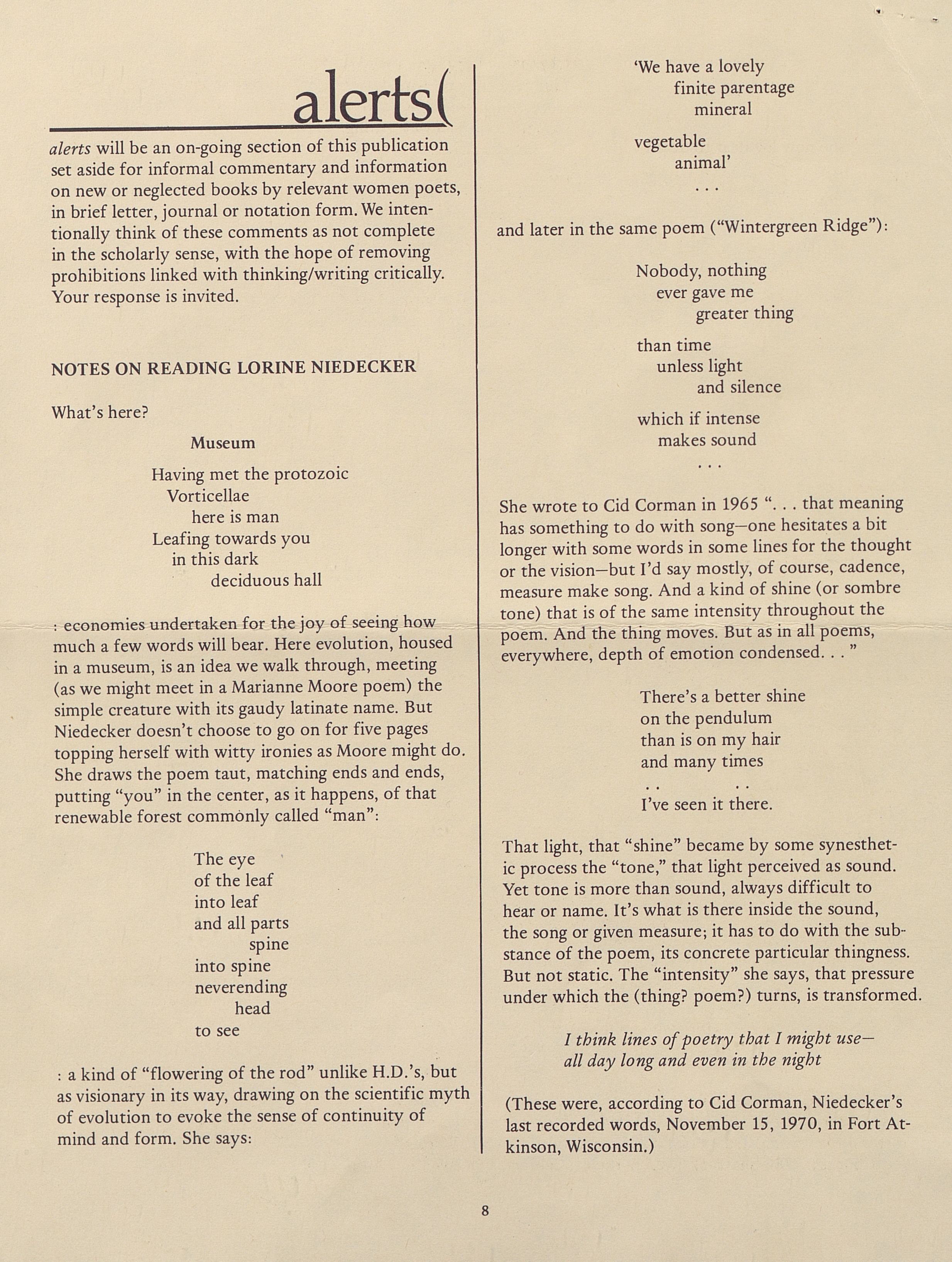
alerts will be an on-going section of this publication set aside for informal commentary and information on new or neglected books by relevant women poets, in brief letter, journal or notation form. We intentionally think of these comments as not complete in the scholarly sense, with the hope of removing prohibitions linked with thinking/writing critically. Your response is invited.
NOTES ON READING LORINE NIEDECKER
What's here?
Museum
Having met the protozoic
Vorticellae
here is man
Leafing towards you
in this dark
deciduous hall
: economies undertaken for the joy of seeing how much a few words will bear. Here evolution, housed in a museum, is an idea we walk through, meeting (as we might meet in a Marianne Moore poem) the simple creature with its gaudy latinate name. But Niedecker doesn't choose to go on for five pages topping herself with witty ironies as Moore might do. She draws the poem taut, matching ends and ends, putting "you" in the center, as it happens, of that renewable forest commonly called "man":
The eye
of the leaf
into leaf
and all parts
spine
into spine
neverending
head
to see
: a kind of "flowering of the rod" unlike H.D.'s, but as visionary in its way, drawing on the scientific myth of evolution to evoke the sense of continuity of mind and form. She says:
'We have a lovely
finite parentage
mineral
vegetable
animal'
. . .
and later in the same poem ("Wintergreen Ridge"):
Nobody, nothing
ever gave me
greater thing
than time
unless light
and silence
which if intense
makes sound
. . .
She wrote to Cid Corman in 1965 ". . . that meaning has something to do with song -- one hesitates a bit longer with some words in some lines for the thought or the vision -- but I'd say mostly, of course, cadence, measure make song. And a kind of shine (or sombre tone) that is of the same intensity throughout the poem. And the thing moves. But as in all poems, everywhere, depth of emotion condensed. . . "
There's a better shine
on the pendulum
than is on my hair
and many times
. . . .
I've seen it there.
That light, that "shine" became by some synesthetic process the "tone," that light perceived as sound. Yet tone is more than sound, always difficult to hear or name. It's what is there inside the sound, the song or given measure; it has to do with the substance of the poem, its concrete particular thingness. But not static. The "intensity" she says, that pressure under which the (thing? poem?) turns, is transformed.
I think lines of poetry that I might use--
all day long and even in the night
(These were, according to Cid Corman, Niedecker's last recorded words, November 15, 1970, in Fort Atkinson, Wisconsin.)
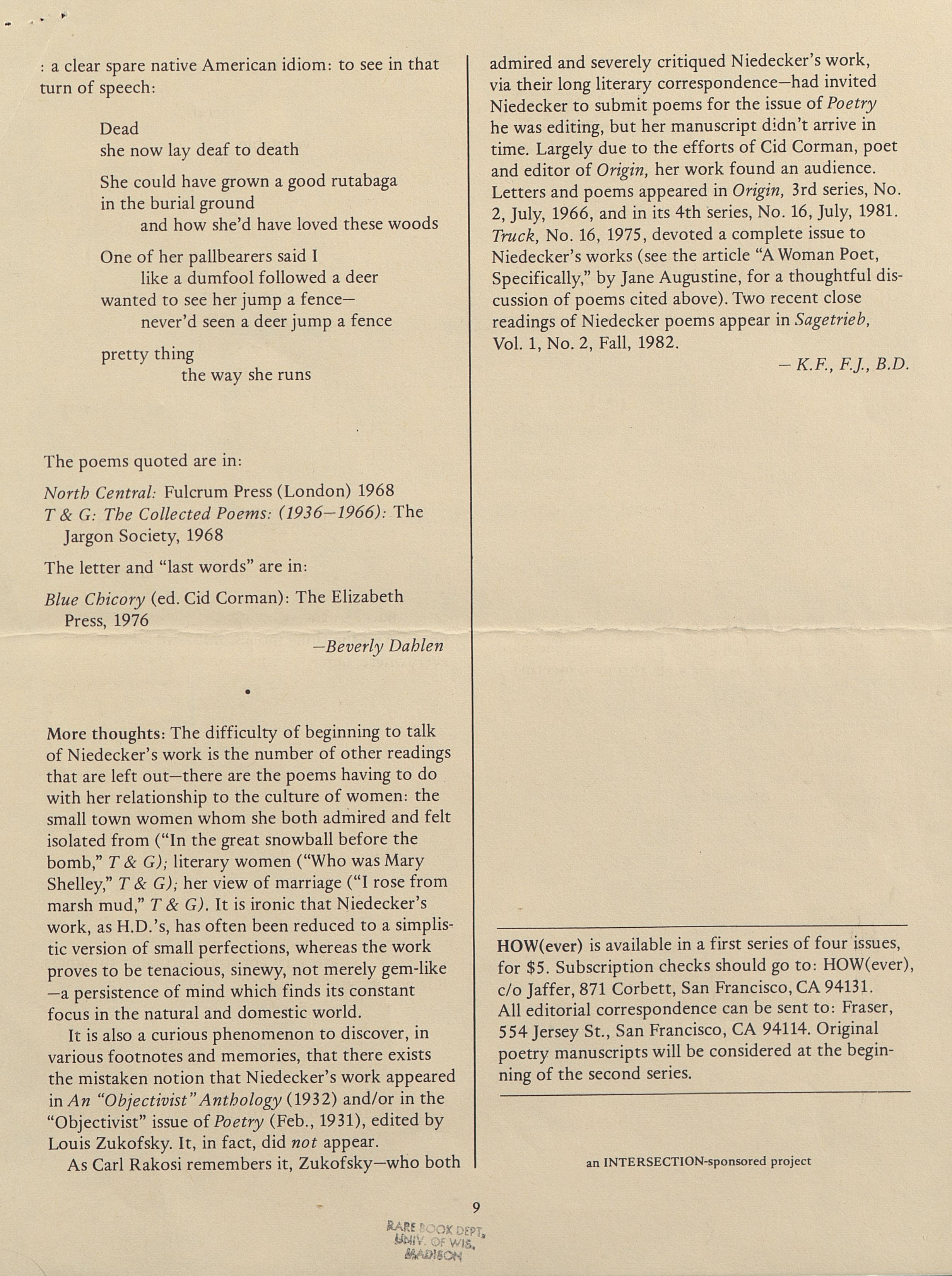
: a clear spare native American idiom: to see in that turn of speech:
Dead
she now lay deaf to death
She could have grown a good rutabaga
in the burial ground
and how she'd have loved these woods
One of her pallbearers said I
like a dumfool followed a deer
wanted to see her jump a fence--
never'd seen a deer jump a fence
pretty thing
the way she runs
The poems quoted are in:
North Central: Fulcrum Press (London) 1968
T & G: The Collected Poems: (1936-1966): The Jargon Society, 1968
The letter and "last words" are in:
Blue Chicory (ed. Cid Corman): The Elizabeth Press, 1976
--Beverly Dahlen
More thoughts: The difficulty of beginning to talk of Niedecker's work is the number of other readings that are left out -- there are the poems having to do with her relationship to the culture of women: the small town women whom she both admired and felt isolated from ("In the great snowball before the bomb," T & G); literary women ("Who was Mary Shelley," T & G); her view of marriage ("I rose from marsh mud," T & G). It is ironic that Niedecker's work, as H.D.'s, has often been reduced to a simplistic version of small perfections, whereas the work proves to be tenacious, sinewy, not merely gem-like -- a persistence of mind which finds its constant focus in the natural and domestic world.
It is also a curious phenomenon to discover, in various footnotes and memories, that there exists the mistaken notion that Niedecker's work appeared in An "Objectivist" Anthology (1932) and/or in the "Objectivist" issue of Poetry (Feb., 1931), edited by Louis Zukofsky. It, in fact, did not appear.
As Carl Rakosi remembers it, Zukofsky -- who both admired and severely critiqued Niedecker's work, via their long literary correspondence -- had invited Niedecker to submit poems for the issue of Poetry he was editing, but her manuscript didn't arrive in time. Largely due to the efforts of Cid Corman, poet and editor of Origin, her work found an audience. Letters and poems appeared in Origin, 3rd series, No. 2, July, 1966, and in its 4th series, No. 16, July, 1981. Truck, No. 16, 1975, devoted a complete issue to Niedecker's works (see the article "A Woman Poet, Specifically," by Jane Augustine, for a thoughtful discussion of poems cited above). Two recent close readings of Niedecker poems appear in Sagetrieb, Vol. 1, No. 2, Fall, 1982.
-- K.F., F.J., B.D.
HOW(ever) is available in a first series of four issues, for $5. Subscription checks should go to: HOW(ever), c/o Jaffer, 871 Corbett, San Francisco, CA 94131. All editorial correspondence can be sent to: Fraser, 554 Jersey St., San Francisco, CA 94114. Original poetry manuscripts will be considered at the beginning of the second series.
an INTERSECTION-sponsored project
Section Images
Click on an image to open a full-screen version.