MEI-MEI BERSSENBRUGGE AND THE USES OF SCIENTIFIC LANGUAGE
Megan Adams is a poet living in San Francisco.
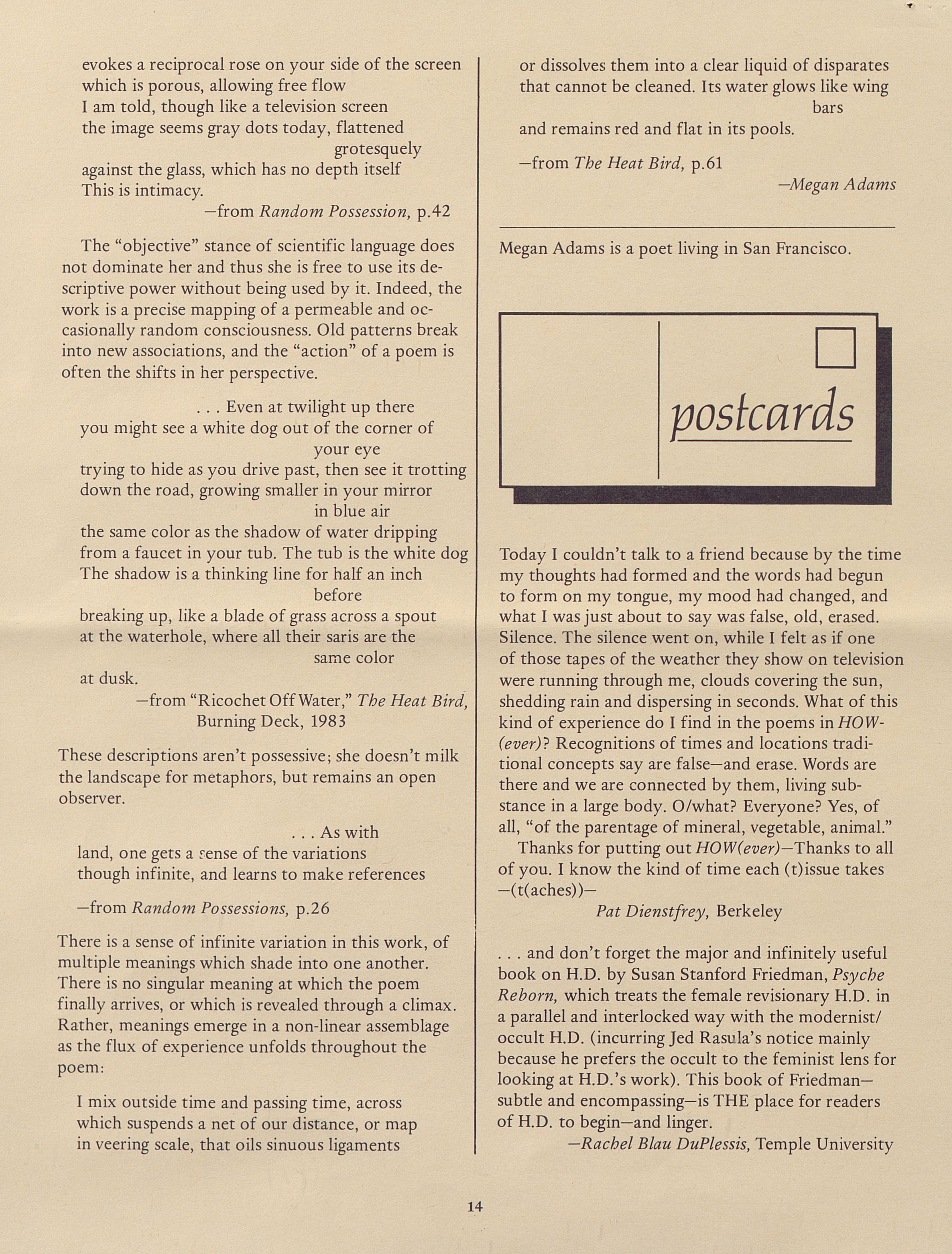
When someone is doing something new it is often only discernible through the initial confusion, after which we perceive that she is not doing what we automatically expect. When I first read Mei-mei Berssenbrugge's poetry, I was initially confused but excited by the novel way in which she used scientific terms and ideas, for her manner subverts the authoritarian pretensions of the language it employs. She incorporates scientific language while remaining completely free of its traditionally loaded implications--i.e., that nature is the brute observed and human consciousness is alienated.
This "oceanic feeling" has no practical value
so we set up the experiment, the current
metaphor-to-be-solved
and send the solution back onto the ocean
like worshippers
It floats for awhile with lighted candles
. . . We strain to imagine flickerings
long after the candles have extinguished
themselves
It's not oceans requiring hypotheses
The ecstasy of the conclusion sustains
the relationship
--from "The Scientific Method," Random Possession, I. Reed Books, 1983
Here, inquiry is a relationship between what is observed and the observer, rather than an opposition, or hierarchical relation. Rachel Blau DuPlessis, among others, has suggested that "both/and" vision is a characteristic of a so-called female aesthetic. Mei-mei Berssenbrugge has the freedom such a vision would imply: she explores herself in parallel with the natural world rather than in opposition to it. She says in the poem "Pack Rat Sieve": "Her senses were shifting ridge-lines, their faces or wings / of varying saturation as this light was moved by clouds." It is usual in western culture to objectify the natural world; in contrast, she is making of herself a natural object. She subverts the subject/object dichotomy, while incorporating the scientific terms which have been used to give it authority. Her poetry functions as a sort of membrane through which experience and observation pass, and are transformed:
Walter calls it a dream screen
What appears at a certain distance on one side
evokes a reciprocal rose on your side of the screen
which is porous, allowing free flow
I am told, though like a television screen
the image seems gray dots today, flattened
grotesquely
against the glass, which has no depth itself
This is intimacy.
-from Random Possession, p.42
The "objective" stance of scientific language does not dominate her and thus she is free to use its descriptive power without being used by it. Indeed, the work is a precise mapping of a permeable and occasionally random consciousness. Old patterns break into new associations, and the "action" of a poem is often the shifts in her perspective.
. . . Even at twilight up there
you might see a white dog out of the corner of
your eye
trying to hide as you drive past, then see it trotting
down the road, growing smaller in your mirror
in blue air
the same color as the shadow of water dripping
from a faucet in your tub. The tub is the white dog
The shadow is a thinking line for half an inch
before
breaking up, like a blade of grass across a spout
at the waterhole, where all their saris are the
same color
at dusk.
--from "Ricochet Off Water,"I, Burning Deck, 1983
These descriptions aren't possessive; she doesn't milk the landscape for metaphors, but remains an open observer.
. . . As with
land, one gets a sense of the variations
though infinite, and learns to make references
--from Random Possessions, p.26
There is a sense of infinite variation in this work, of multiple meanings which shade into one another. There is no singular meaning at which the poem finally arrives, or which is revealed through a climax. Rather, meanings emerge in a non-linear assemblage as the flux of experience unfolds throughout the poem:
I mix outside time and passing time, across
which suspends a net of our distance, or map
in veering scale, that oils sinuous ligaments
or dissolves them into a clear liquid of disparates
that cannot be cleaned. Its water glows like wing
bars
and remains red and flat in its pools.
--from The Heat Bird, p.61
--Megan Adams
Article Images
Click on an image to open a full-screen version.