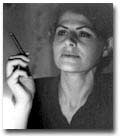
Eleni Sikelianos is the author of to speak while dreaming, The Lover's Numbers, The Book of Tendons and, forthcoming, Crimson Coat/Crimson Coat Narrative. Sikelianos was recently conferred the James D. Phelan Award for California writers, and a Fulbright Fellowship for a writing project that will take place in Greece.
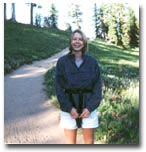
Jo Ann Wasserman’s work has appeared in journals including The World, Grand Street, and Blue Book Poetry. From 1992-1997 she worked in multiple capacities at the Poetry Project at St. Mark’s Church, including curating the Wednesday Night Reading Series. Wasserman’s first chapbook of poems, what counts as proof was published by Sugar Books in May 1999.
Dialogue on work process
JAW: When we had lunch in New York, you spoke about feeling a renewed need to communicate in your poems. How are you feeling right now about making something known in the poems?
ES: I like the idea of the poem as a variably open or closed vessel, written and read by variably open or closed readers who are not predetermined by a particular course of study. Maybe I am curious about the generosities/asperities one offers the reader, and the poem as a variably communicable (like a disease or joy or sex) or incommunicable (like death) body.
What is being communicated, and how this occurs is, of course, potentially very diverse, and, here, you would not want to be confined to a unilateral form of articulation. I guess I’m interested in the shifting spectrum of communicability/ incommunicability within which a poem can exist, which means, maybe, that I’m interested in its public and private nature.
In communication, there might be something about the poem’s economy. As a reader, I look for yield: this is "good for me," or it’s pleasurable–sometimes it’s both. If I am my own implied reader, what are my rewards? As a writer, I have become more and more engaged in the communication between me, or some part of me, and the poem. The California poem feels like the closest I’ve gotten to a certain part of me. While there seems to be a general trend towards the savvy use of artifice, I’m developing an interest in the artless part of the art.
JAW: I know you have worked on longer pieces and in the accretion model of the series. Is this a comfortable way for you to work?
ES: I seem to have trouble conceiving of an individual, short poem. I think this is partly because I often have some form of narrative project or impulse involved (with a very wide definition for narrative). I have almost only ever worked, with any success, serially; the trap there seems to be that you find 64 different ways to say the same thing. I wanted to try to extend my sense of continuity, to write a continuous piece (as California is continuous, as time is, etc.), a novelistic or epic approach. There are interruptions (as time is interrupted, as memory is, etc.) in the poem (I’m still trying to figure out how to handle them), but there is, alas, no hero. I am trying to add the vestigial tailbone of one now.
JAW: When you speak in the poem of "A spine brought to the whole length of California," are you grappling with the size of this poem’s project (or in a sense, any poem’s project)?
ES: And the vertebral structure of the Sierras laid out along the state, trying to connect that to the outlying areas (where I was) and, yes, trying to find some way to unify or give structure to the poem through that.
JAW: I was just reading the new Jack Spicer biography (Poet Be Like God by Kevin Killian and Lewis Ellingham) and Spicer who, like you, was a Southern Californian, was quoted as saying, "I want to write a poem as long as California." Do you ever think of Spicer when you think about your California poem?
ES: No, maybe I should.
I do think of other poets, and writers, who were born in or spent significant time during childhood in California, especially Southern California. There’s Joanne Kyger, Carla Harryman and Barbara Guest–Basil Bunting taught a few blocks away from me when I was a kid, although, of course, he wasn’t from there (Isla Vista), and I’d never heard of him at the time. Hugh Kenner was around, as well as Rexroth. I think of Duncan, up north, and I think about Martha Graham, and her statement, something like "I couldn’t have made the kind of dance I made, had I not grown up in such a hedonistically beautiful environment." (Graham moved to Santa Barbara as a child.) I think a lot about the landscape, the flora, the colors. I think about the length and variety of its environments. As a teenager, I spent a lot of time in the mountains, on the beach, days and nights outdoors. It really was a kind of Eden, a pre-Raphaelite paradise, and that was the context for these rather brutal activities that occur in families, my own and other people’s, and in the politics (don’t forget Reagan had–is he still alive?–his ranch near my hometown) and in class and race distinctions and distortions. Steinbeck was an early love. But the landscape is probably more of a local influence. It occupies that pale, fuzzy homeward lost paradise in my mythography.
JAW: I love when the poem says that no one in California says bodega, because that is a reference to a way of speaking that is New York City vernacular and this sets up a kind of foil for California. Do you feel that there is a translation issue in the poem? I mean you now live in New York and base your writing life there. Does living outside California give permission for this poem to exist? Does the poem exist for you in both places or some third "California of the mind?"
ES: I don’t think I could have begun the poem in California. In particular, being on the East Coast, and all the kinds of binary thinking that brings in, helped to trigger it. I keep wondering what Californians will think, but also what will those who have never been to California make of it?
Where does the poem exist? This troubles me (when I think of readers), but the truth (or something like it) is that it exists both places (here and there) and neither, because its logistics are really also a lost American (my American) past. The area in which I grew up (Goleta, just north of Santa Barbara) has changed drastically in the last twenty years. The poem takes place in an era that is not pre-strip mall, but pre-preponderance of strip mall. A belief in the endlessness of fields meets the endlessness of subdivision mushrooms.
JAW: Does the poem begin to locate both in space and time for you? When I speak of time and space, I am thinking about how the poem can bring me to a growing up time in the 1970s. Particularly the line about dirt bike races. God, that triggered a whole tableau. It seemed like all the kids I would want to be who were on TV lived, decidedly, in California at that time (i.e., "The Partridge Family," "Family," "Eight is Enough"). It is as if this was the first generation of characters who pointedly resided in California and not in Anytown, USA. For me, living on the East Coast, California seemed like the perfect, best place to be young. Do you feel that what I am describing as a sort of Californiafication of our youth is a part of what your poem is encountering?
ES: I went to visit my cousins in Detroit when I was eleven, so I could tell, I could tell that California was the center of the universe. Some poeple say it’s Paris, others Delphi; I know it’s not Detroit. But it was a kind of oblivious/obvious thing. On the other hand, no one I know ever feels in the center at all, and there were all the ironies of living in a housing project just outside of Santa Barbara, of being poor and attending a school with affluent children, of living in a family of freaks in a very conformist environment. Conformism was an extreme pressure on many levels, from the physical demands of beach-bunnydom to a kind of bland anti-intellectualism and soft-core spirituality (usually all in cahoots, i.e., to be anatomically correct was to be spiritually correct, etc.). So there was this feeling of being really out of it–physically, financially, class-wise–basically of being, at the axis of all good things in the universe, very off-center; and I suppose that really entices me as a point of exploration and as one impetus for the poem.
The time thing comes into it in that Proustian sort of way, where you’re trying to gather and re-collect and reinvent a time, but more than that, or through that, a self, which is quite elusive. How does time past configure, become or not become a part of, a present self? Writers invent themselves. I am intrigued by the interrupted and continuous arc through time that is or is not me. So much of that passed through a particular locale (the northern edge of Southern California)–I simultaneously try to deny and am flabbergasted by how much place does indeed work its wiles upon us. Here, we could replace "place" with "place and time," a single entity.