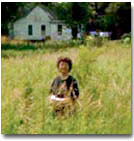
Bobbie West grew up on a farm in Illinois. After drifting into various jobs as a waitress, union machinist, teacher, and translator, she discovered poetry. Since then, her writing has appeared in a variety of literary magazines. She's the author of a chapbook, Scattered Damage (Meow Press, 1998), and assistant editor of A Wild Salience: the Writing of Rae Armantrout, forthcoming from Burning Deck Press. Currently, she works at a public library in the San Diego inner city neighborhood where she
Defining "class" and "working class poetry"
The space provided by this forum is hardly large enough even to name the beast, let alone to say something significant about it. And "working class" may be too narrow a term to use here, when what we're really talking about are perceptions of various states of suppression and exclusion. The term I prefer is "lower classes" (emphasis on the plural), which includes not only people of urban working class backgrounds, but also the chronically unemployed and the rural poor, who have certain life circumstances and expectations in common, as well as some common aesthetic preferences.
When it comes to literary production, class pervades every aspect of it. For people of the lower classes, the common denominator is "have-not" status, starting with the glaring absence of the middle/upper class assumption that it is always possible to achieve what one desires. There's a lack of cash to support money-losing ventures such as poetry magazines and small presses (owner/editorship of which gives one instant recognition). There's a lack of access to the Internet, where one can hobnob with publishers and magazine editors (publication being determined partly by who you know: For example, this particular essay appearing in this particular forum is a result of having met someone [Kathy Lou Schultz] at an academic conference and having contributed to an Internet discussion).
An even more basic lack is that of access to the kind of education that can equip one with an understanding of which particular aesthetic modes of thought and presentation are valued and which are not, an education that trains one to produce in those modes, while also providing the skills needed to innovate and rebel against them.
Even if one achieves access to these things, there are still difficulties. Whose aesthetic values should an individual lower class poet be willing to accept? While disjunctive techniques seem to be commonly enjoyed and employed by all contemporary poetic "innovators," I've noticed some differences in other aesthetic components that seem to fall along the old academic/non-academic (and therefore also class) lines. For example, why does the tone of so many "innovative" poetry magazines seem to be dominated by an intellectual, white-sounding verbal style, with lots of iambs and not much syncopation? Why are emotion, pathos, and melodrama (of which I am quite fond, and which fondness I believe is due in part to a lower class background) discounted, while philosophical conundrums are praised? Why shouldn't we be free to utilize the full range of expression available to us as human beings – the emotional and particular as well as the abstract and philosophical, cacophonous as well as harmonious? Must all of our poetic endeavors "reek of brains" (as a friend once put it) in order to be valued?
Questions like those lead to the one asked by the editors of this forum: "What is 'working class' poetry?" For me, it's all of the poetry, whether mainstream or avant garde, written by people who identify themselves as working class, particularly when it deals with the dynamics of economic and cultural power hierarchies and their effects on us as a class (and as individuals), and that expresses our resistance to them. I, as an individual, tend to prefer innovative styles of poetry because they can so effectively express the sense of disconnectedness, disturbance, distortion, difficulty, and disaffection that often results from life in the lower classes.