
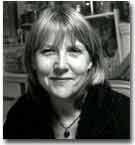
Dodie Bellamy is the author of The Letters of Mina Harker (Hard Press, 1998). She is a visiting writer of fiction at Mills College.
(Photo by Craig Goodman)
Forum response
Whether I like it or not, I am a product of the San Francisco writing community. For the past 20 years this community has nourished and incensed me. Any ideas I have about class in my own writing are framed by my class experience within this community, a community whose class politics I don't have much good to say about. Presenting my critique of (my fantasy of) this middle class writing scene, I fear, is a losing proposition. "She's such a whiner," people will scoff. I've seen this happen time and again when such critiques come up on the SUNY Buffalo Poetics List. I, and many other working class people, have been helped by this scene (trained, given access and encouragement) but treated badly by it as well (kept on the peripheries, tolerated rather than accepted, denied difference). This treatment has a different flavor than the coddling and patronizing writers of color endure. Being working class is like being fat. It's your own fault. You'd do something about it if you really cared about yourself.
When I was a young writer I went through a rigorous period of training. My manner and public presentation, as well as my writing, were minutely critiqued. "Writing is a middle class occupation," a Marxist friend told me. "If you want to be a writer, Dodie, you've got to learn to be more middle class." Another mentor volunteered that my brown eyeliner was too harsh. "D. and I have been discussing your eyeliner, and we think that green might work better." I feel a lot of anger about this interaction–particularly when I'm in PMS and thrashing about for something to obsess about. An appalling overtness that resonates with the thousands of other more covert messages received in the past twenty years. I see bald, disapproving moon-heads, straight out of a Sylvia Plath poem. They scowl at my social coarseness, my primitive, black and white value system–the way I pouted and scoffed when my teachers suggested I make friends with people who will "do you some good." This standard operating procedure in a community that's jousting for power is dishonest in a working class context, where there is so little power to be had. It's not like you never see such "networking" there, but it is considered BAD. I tend to think of middle class people as immoral and fussy. "Corn cobs stuck up there asses," as my mother would say.
Whenever I see a cheap (white) woman on the street–not some trendoid doing cheapness, but a really unselfconsciously cheap woman–I get a sexual thrill, I stare and stare at her blue eyeshadow, her inch-long rhinestoned nails, lipstick stained cigarette, hairspray, too tight jeans, pasty cleavage, my eyeballs bulge with staring. Lacy thong bikini, I'm sure of it. My "novel" The Letters of Mina Harker, is the place where I get to be that cheap woman–if she had a voice, if she had years of training. Mina is a place where I get to rip loose, to be vulgar, unruly, to shit all over everything, to wail like a hysterical baby, to brandish the hatchet humor I was raised with. Much of the permission for wallowing in all this primalness comes from Lacanian theory. In Mina my Lacanian desire is twofold: I wanted to both enact the delicious twistedness of his theories and to subvert previous "prissy" feminist enactments. At this point, however, I can make no clean separation between these feminists and me–neither inside nor outside of my writing. Compared to the women I was raised with, I've become "prissy" myself. One cannot spend one's entire adult life living and working among a middle class intelligentsia without being tainted. Clashings and slippages of class codes generate energy, excitement. Look at Audrey Hepburn in movie after movie, madly changing from flower girl to lady, from bookseller to supermodel, from chauffeur's daughter to millionaire's wife, from farm wife to bohemian, from princess to vacationing nobody. If Audrey stayed put, nothing interesting would ever happen to her! Gowns by Edith Head, romance by Gregory Peck, book by Hard Press, fountains by Rome. It's all been worth it, I tell myself.