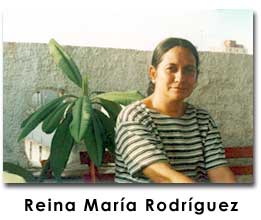
Reina María Rodríguez: These poems were originally published in Reina María Rodríguez’ 1998 book, La foto del invernadero (The Photo of the Greenhouse), with which she won her second Casa de las Américas prize. Previously she published numerous collections, winning not only her first Casa de las Américas prize (in 1984) but also Cuba’s Julián del Casal and National Critics’ prizes and Mexico’s Plural award for poetry. Today Rodríguez continues to live and work in Havana. She is known not only as a poet but as the host of an important alternative cultural salon: for two decades her home has been both a private and a public space. Intellectuals gather at her rooftop apartment, the azotea, to present work and discuss their ideas with a degree of freedom not always found in official cultural institutions. Although she states that the departures of many fellow intellectuals have affected the level of cultural activity on the island, Rodríguez continues to seek new challenges and opportunities. She now works with Antón Arrufat to edit their new magazine about poetry and poetics, Azoteas.
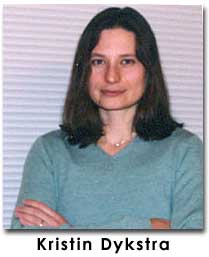
Time’s Arrest / La detención del tiempo, a collection of Kristin Dykstra’s translations of poetry by Reina María Rodríguez, was published by Factory School Press in 2001. A.BACUS will feature recent translations in a special 2002 issue dedicated to Rodríguez. Previously, Dykstra co-translated the Rodríguez anthology, Violet Island and Other Poems (forthcoming from Green Integer Press); selections will appear in boundary 2: An International Journal of Literature and Culture and have been published in Hopscotch: A Cultural Review 2:2 and Zazil 1. Dykstra is guest editor of Mandorla: New Writing from the Americas 7 and edited the Factory School web project “Seven Cuban Poets.” Her 2001 interview with Reina María Rodríguez, “Un deseo de querer eso que no es,” is forthcoming in Actual: Revista Literaria.
the difference
I, who have seen the difference
in the shadow that objects still cast across my eyes
— passion for reconstructing loss;
extravagance of sensation —
in the only country that isn’t far away,
where you go. where you stay.
I know your days are marked
on the terracotta tablet
— dating from the reign of some king or another —
in Japanese calligraphy that reminds me of wrinkles.
the days are the place where we live.
there’s no space other than the strip over which your eyes
pass at sunset.
you won’t be able to choose any other place, only
the location of the days,
their difference.
and in that crack between two worlds
to be reborn into a (more aesthetic) species
where we could live according to another awareness of the days
without the extravagances of each conquest.
a haunted house on the corner of San Rafael
…from room to room they went, hand in
hand, lifting here, opening there, making sure —
a ghostly couple…
V.W.
a haunted house doesn’t reveal its prior encounters easily; it doesn’t inform on the intimacy of the couple who inhabited it. clothes hanging from the doors, a half-made bed and a clock continuing at its implacable rhythm. you, you’re there when I arrive, and we seat ourselves in two heavy wooden chairs. (I still don’t know how the morning light gets in.) my black stockings slide smoothly between your hand and your mouth, covering the foot that you prefer. it’s cold. she’s watching us. he too crosses with my image in the mirror, to remind us that this time we, you and I, are the apparitions in perpetuity. below us, remains of other boats move past, and in this space, protected from pollution, disorder and fear, an infinite energy overflows from us, returning our shape and proportion, accompanying us among these strange objects that will receive us. I feel so remote and so present that I’m frightened by the doors, their varnish, the deteriorating decorations on the ceiling. it was meant to be such a beautiful house! — now I recall my slow exploration of Marimbad, that time, moving through the city at night. I dream of plaster figurines that hardly move at all but still travel around a pool, and if I get close to that pool, it’s filled with blood (I’ll bathe among those plastic tubes, on the rotting porcelain of the antique bathtub). at this sensation of familiarity, my intimacy surges up like a prior life, and I’m that woman who, at that time, and strangely, had given up knowledge. you follow her to convince me that I am, finally, unmistakably, that woman. you’re carrying a cube of water (a cube made of metal; the water balances inside, quivering, in its new dimension of whitened gold). I know it’s the nothingness, the domestication of that unrecognized void revolving between us and the gray curtains at the scene, which we slowly approach with imperfect staging: the entire body prepared for obedience without resurrection; knowledge — like a black dress — sprawled across the enormous bed. I exchange this representation for a day of contemplation. from the decorated ceilings; from the sequence of ceilings that used to be golden, I make a brusque motion by the bathtub, by the varnish of the door that opens into my mind — undesirable phantoms from a house closed off to us by its curtains. and still it stalks us, it disturbs the potency we’ve acquired; it accuses us and demands our return… vampiric house. I look at you, like one looks at engravings in old books with ships that will sink with their treasures at sundown. we won’t come back to you. collapsing, a sound intensifies in my ears: with you we will also flee the stubborn illusion of having been here, body and substance. occupation without a calling. awareness of an identity inside me, inside her, woman taking shelter in a gesture of condemnation. I don’t know what she was trying to prove with her efforts (ill-fated metaphysics, ill-fated desire). I went down one more time and merged with my guilt, with my incapacity, always looking for a house on the corner of my desire, and she — far from my insignificant eye — was becoming ever more apparent, ever more real, like light becoming more luminous when you don’t want to see it.